Maxim Bozinovic
Selected Projects & Papers
I am a senior at Burlingame High School. I like projects where math meets people and policy. This year I built a compliance-first ROI model for airport accessibility, a 10-year air-quality study of Niš (Serbia), and a computer-vision tool that recovers tennis broadcast camera geometry from a single frame. Below are short summaries with links to papers and artifacts.
1. Airport Accessibility:
ROI Analysis
Making the case for implementing solutions to help deaf people travel better.
2. The Study of Air Pollution in Niš, Serbia
I chronicled a decade of PM2.5 in Niš (my parent's hometown). I showed a strong seasonal cycle and frequent exceedances of WHO guidelines.
3. Camera Calibration for Tennis Broadcast
What's the optimal position of tennis camera?


Project 1: Airport Accessibility: Compliance-First ROI (with Prof. R. Karapandza)
Goals:
Show that AI sign-language services (e.g., SignAvatar) are a compliance unlock—not just a revenue add-on. After my summer 2025 full-time internship, I worked to reframe value prop from “incremental passenger revenue” to compliance unlock: quantify funding unlocked, regulatory risk avoided, and operating cost savings.
Why compliance beats pure revenue as value prop:
Deaf and Hard of Hearing (D/HH) demographics make a demand-side revenue model weak (older age profile, lower median income, small under‑40 segment). We reframed question: Will airports invest $75K to unlock $5–15M in federal funding and avoid $500K+ in penalties—plus gain operational savings?
New ROI:
Funding unlocked + regulatory risk avoided + compliance cost savings + (bonus) incremental revenue.
Deliverables (in progress):
Regulatory map (ADA/ACAA), federal-funding playbook, compliance gap analysis by airport, ROI calculator, and sales collateral.
Mentorship:
Prof. Rasa Karapandza (EBS Business School; policy/econ).
Context:
This project builds on two years of internship work at SignAvatar (speech‑to‑sign AI, product QA, dataset building, outreach), aligning the business case with accessibility enforcement and infrastructure funding cycles.
Project 2 — Smog in Niš, Serbia (three-paper series)
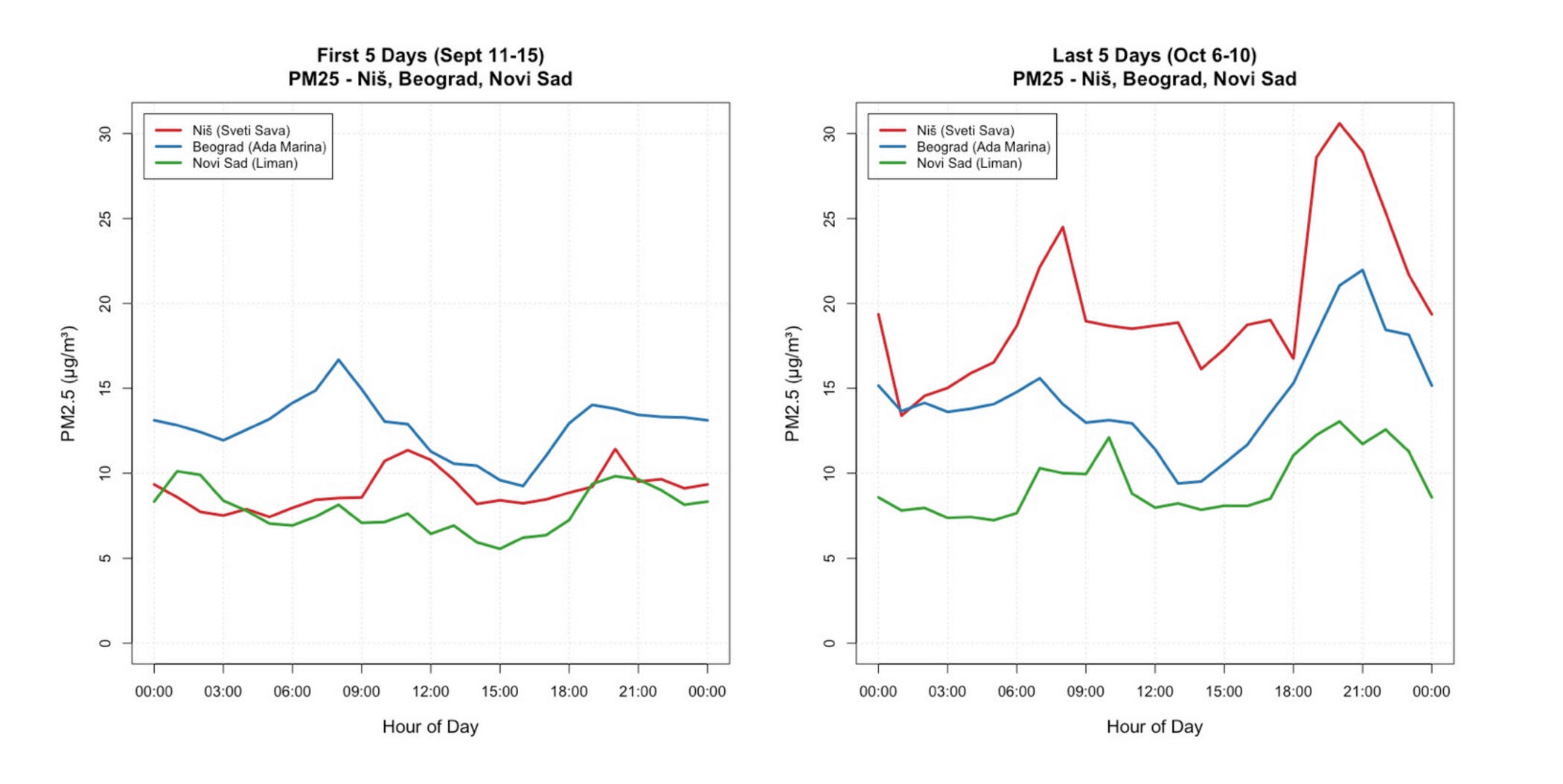
Summary: 10‑year and multi‑station analyses show a severe winter smog pattern in Niš with frequent exceedances of WHO guidelines, cross‑validated across two independent monitors, and early-season divergence vs. Belgrade and Novi Sad.
Key results (highlights):
- Seasonality: Winter PM2.5 ≈ 3× summer; long‑term trend improves since the 2018–2020 peak but severe episodes persist.
- Validation: Two stations move together (Pearson r ≈ 0.973, ~1,965 overlapping days) → city‑wide signal, not site noise.
- Early‑season signals: In September–October 2025, Niš shows an evening rise in PM2.5 and NOx; SO₂ stays flat/low → fingerprint consistent with wood‑dominant residential heating.
Recommended public-health actions:
Expand monitoring/transparency, targeted evening alerts, MERV‑13/HEPA “clean‑air rooms,” and public‑facility fuel switching.
Project 3 — Tennis Broadcast Camera Geometry (computer vision)
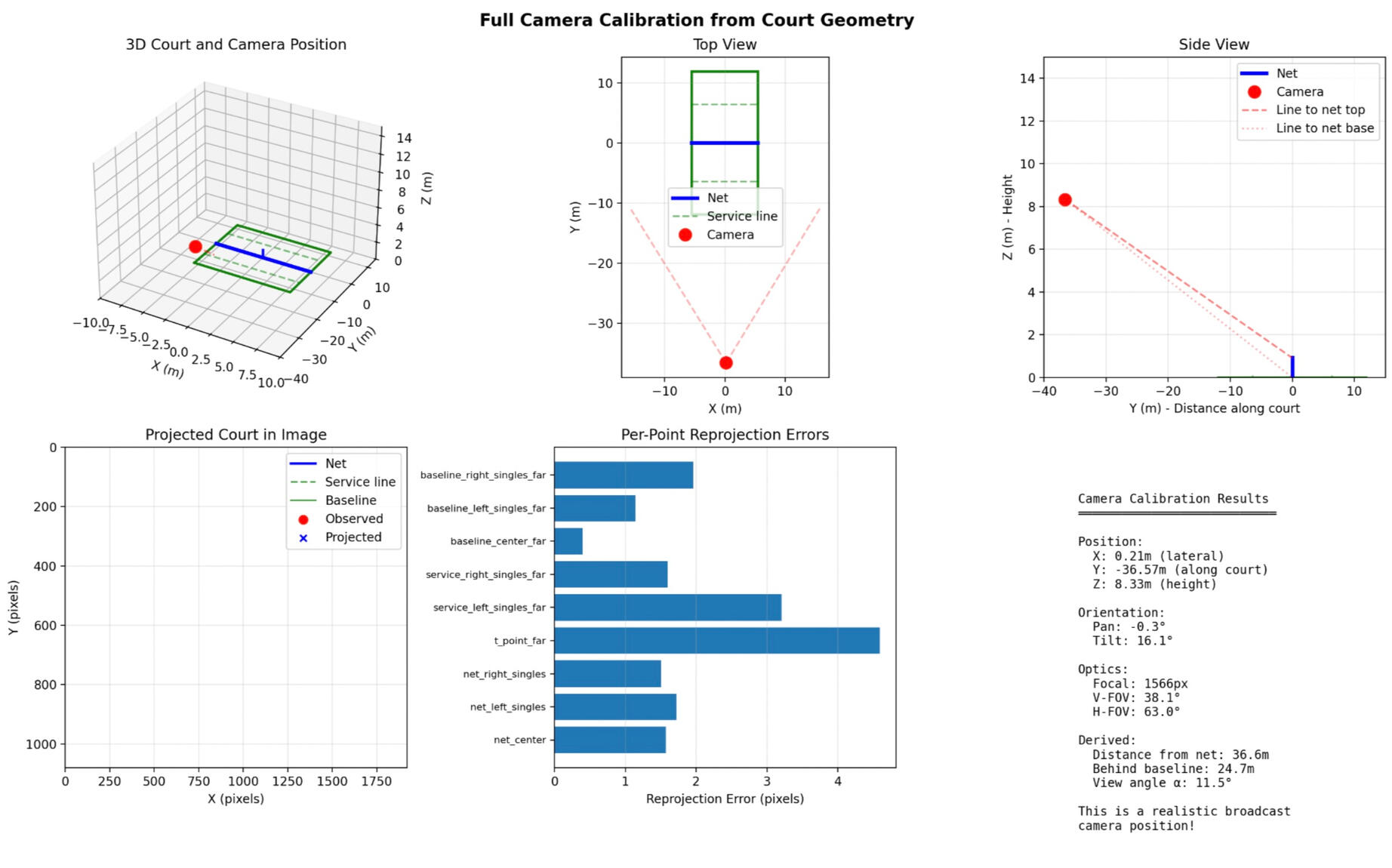
From a single TV frame, solve a pinhole camera model against standard tennis‑court geometry to recover x, y, z, focal length, pan, and tilt, and then compare across events/courts.
Sample results (finals):
- Australian Open 2024: tilt −14.9°, viewing angle α 12.3°.
- French Open 2025: tilt −15.0°, α 13.3°.
- Wimbledon 2019: tilt −11.6°, α 10.9°.
- US Open 2025: tilt −19.2°, α 15.5°.Why it matters: Quantifies how broadcast geometry shapes viewer perception (depth, speed cues). Enables data‑driven feedback to broadcasters and a fan survey on “favorite cameras.”
Downloads (PPTX):
About & Contact
Interests/skills: applied math, statistics, Python/Java/R, sports analytics, data viz.
Athletics & leadership: varsity tennis (co‑captain) and water polo (captain/MVP); math & physics tutoring; Slavic Club president.
Resume: see my CV for coursework (MV Calc, Linear Algebra, ODEs, Discrete Math). SAT 1570.
Email: [email protected]